
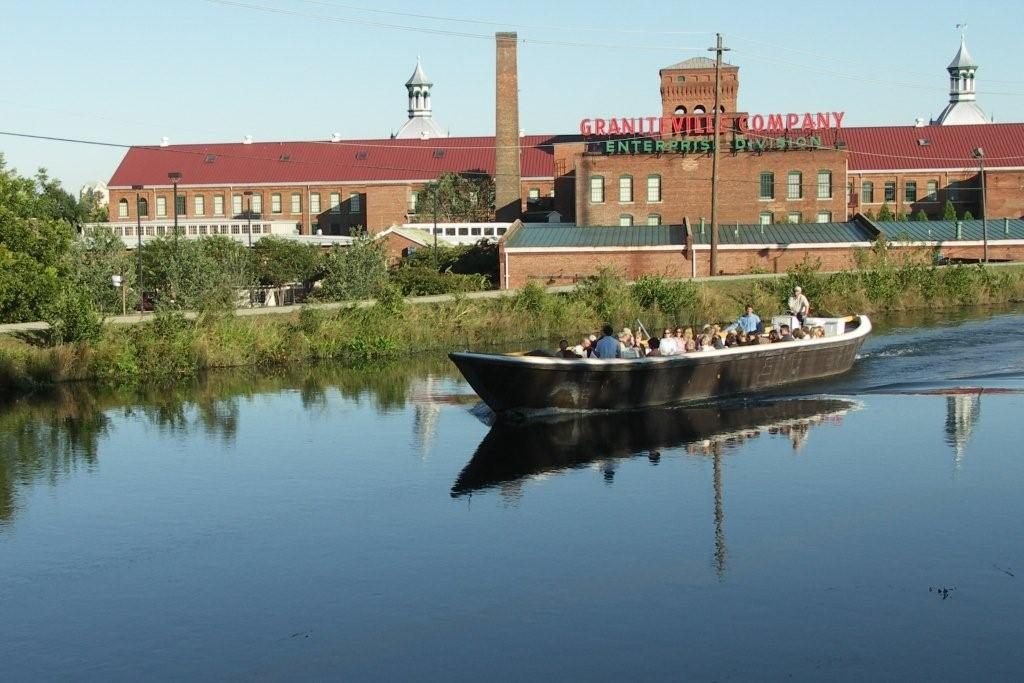
Photo: Sregor54, CC BY-SA 4.0, via Wikimedia Commons
The Augusta Canal, opened in 1845 and enlarged after the Civil War, turned Augusta into one of the South’s biggest mill towns, and the mills, churches and townhouses it paid for still line downtown. This self-guided walk starts at the canal’s Discovery Center, follows the mill district, then loops through the downtown historic district laid out in 1736. Most downtown stops are a few blocks apart on Broad, Greene, Telfair and Reynolds streets; the mills are a longer walk or a short drive west along the canal.
- StartAugusta Canal Discovery Center, Enterprise Mill, 1450 Greene St.
- TimeHalf a day on foot, or a morning boat tour plus an afternoon walk
- ParkingFree lot at Enterprise Mill; metered and garage parking downtown
- Heritage areaAugusta Canal National Heritage Area
The Canal and Mill District
1. Enterprise Mill and the Discovery Center
A granite flour mill of 1848 that grew into a cotton mill and ran until 1983. The Discovery Center inside sells boat tour tickets. Read our Augusta Canal history.
2. Sibley Mill and the Confederate Powder Works chimney
The Confederate Powder Works stood here from 1862 to 1865, the only major buildings the Confederate government ever built. Only its tall chimney survives, in front of the 1880 Sibley Mill.
3. King Mill
A textile mill incorporated in 1881 and named for John P. King, a U.S. senator who drove the canal’s construction.
4. Engine Company No. 1
The first firehouse built by the city as a public building, a storefront-style station of the late 1800s.
Sponsor This Walk
Put your Augusta restaurant, shop, tour or hotel in front of visitors exploring downtown on foot. See our advertising options or download the 2026 media kit (PDF).
Broad Street and the Riverfront
5. Augusta Cotton Exchange
Built in the mid-1880s at the height of the cotton trade, with ornate cast-iron details, near the Riverwalk.
6. St. Paul’s Church and the Riverwalk
On the site of Augusta’s first church of 1749 and colonial Fort Augusta, which became Fort Cornwallis in the Revolution. Step through to the Riverwalk along the Savannah River.
7. Old Government House
Augusta’s seat of local government until 1821, later an elegant private home.
8. Lamar Building
One of Augusta’s first modern office towers, rebuilt after the great fire and topped by a distinctive penthouse.
9. Sacred Heart Cultural Center
The 1900 Sacred Heart church, with patterned brickwork and twin spires, now a cultural center.
10. Church of the Most Holy Trinity
A Catholic church designed by John Rudolph Niernsee, one of the leading Baltimore architects of the mid-1800s.
Telfair and Greene Streets
11. Old Medical College
An 1835 Greek Revival building, a National Historic Landmark, built for the Medical College of Georgia.
12. Woodrow Wilson Boyhood Home
Where the future president lived as a boy; his father led the nearby First Presbyterian Church, designed by Washington Monument architect Robert Mills.
13. Joseph Rucker Lamar Boyhood Home
An Italianate house that was the boyhood home of the U.S. Supreme Court justice.
14. Gertrude Herbert Institute of Art
A Federal-style house built by Mayor Nicholas Ware, known as Ware’s Folly, now an art school and gallery.
15. Brahe House
A townhouse with a full English basement, unusual among the downtown district’s houses.
16. Lucy Craft Laney Museum of Black History
A short drive or long walk northwest, in the Laney-Walker district, the home of the pioneering educator. Nearby is Springfield Baptist Church, tracing its roots to 1773.
Plan Your Visit
Pair the walk with a canal boat tour from the Discovery Center, then see our 10 best things to do in Augusta for Phinizy Swamp, Meadow Garden and Masters week. Our downtown historic district and Augusta historic sites pages have more buildings to find.
Common Questions
Can you walk along the Augusta Canal?
Yes. A towpath runs along the canal from downtown up to Savannah Rapids Park, and it is open to walkers, runners and cyclists. Downtown, the canal passes the Enterprise, Sibley and King mills.
What is the chimney on the Augusta Canal?
It is the chimney of the Confederate Powder Works, which made gunpowder from 1862 to 1865. It is the only part of the works still standing, in front of Sibley Mill.
How long does the walk take?
Allow about half a day to see the mills and the downtown stops at a relaxed pace, or a full day if you add the canal boat tour and a museum.
Sources we checked
Facts on this page were checked against official sources and our own detailed pages for each stop. Hours, fees and access change, so confirm before you go:
- Augusta Canal National Heritage Area: Discovery Center hours, boat tours and reservations
- Historic Augusta: downtown landmarks
Spot something out of date? Email Contact@n-georgia.com and we’ll check it against the official source. Read how we research our guides.