
Photo: Thomson200, public domain, via Wikimedia Commons
Georgia saw some of the war’s biggest campaigns, from Chickamauga in 1863 to the Atlanta Campaign and Sherman’s March to the Sea in 1864. This guide lists more than 40 places to see it today: battlefields, coastal forts, museums, cemeteries, railroad sites and antebellum homes.
Planning a route? Our campaign guides list the sites in order: Atlanta Campaign, Chickamauga and northwest Georgia and March to the Sea. Or see the Georgia Civil War sites map and Atlanta Civil War sites map.
- Top Sites
- Battlefields and Battle Sites
- Forts
- Museums
- Prisons, Cemeteries and Memorials
- Railroads, Mills and Industry
- Historic Homes and Towns
Top Civil War Sites in Georgia
| Site | Where | Why go |
|---|---|---|
| Chickamauga battlefield | Fort Oglethorpe | Site of the largest battle fought in Georgia, September 1863 |
| Kennesaw Mountain | Kennesaw | Earthworks and the June 27, 1864, assault; summit trails |
| Pickett’s Mill | Dallas | One of the best-preserved battlefields in the nation |
| Andersonville | Andersonville | Camp Sumter prison, national cemetery and POW museum |
| Fort Pulaski | Tybee Island | Masonry fort breached by rifled cannon in April 1862 |
| Fort McAllister | Richmond Hill | Best-preserved Confederate earthwork fort |
| Atlanta History Center and Cyclorama | Atlanta | Battle of Atlanta painting, the Texas locomotive and a major Civil War exhibit |
| Southern Museum | Kennesaw | The General, from the Great Locomotive Chase |
| Port Columbus | Columbus | Remains of the ironclad Jackson and gunboat Chattahoochee |
Battlefields and Battle Sites
Chickamauga and Chattanooga National Military Park
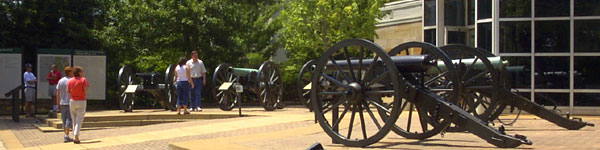
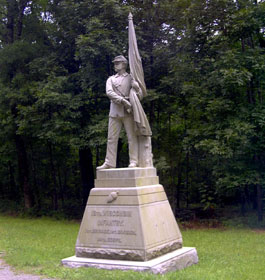
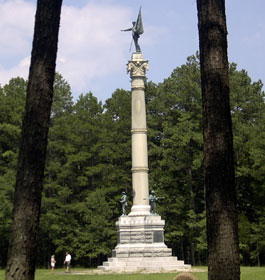
The first and largest of the national military parks preserves the Chickamauga battlefield, where the September 1863 battle was the largest fought in Georgia, along with Lookout Mountain and Missionary Ridge across the Tennessee line. Most of its 1,400 monuments and markers were placed by veterans of the battles, led by Henry V. Boynton. More on Chickamauga and Chattanooga National Military Park
Kennesaw Mountain National Battlefield Park
Some of the heaviest fighting of the Atlanta Campaign happened here on June 27, 1864, when Sherman’s frontal assault on the Confederate line failed. The park preserves earthworks, cannon emplacements and monuments on a battlefield the National Park Service calls hallowed by the sacrifice of more than 5,000 Americans, with a visitor center, museum and trails to the summit. In Kennesaw, GA. More on Kennesaw Mountain National Battlefield Park
Pickett’s Mill Battlefield State Historic Site
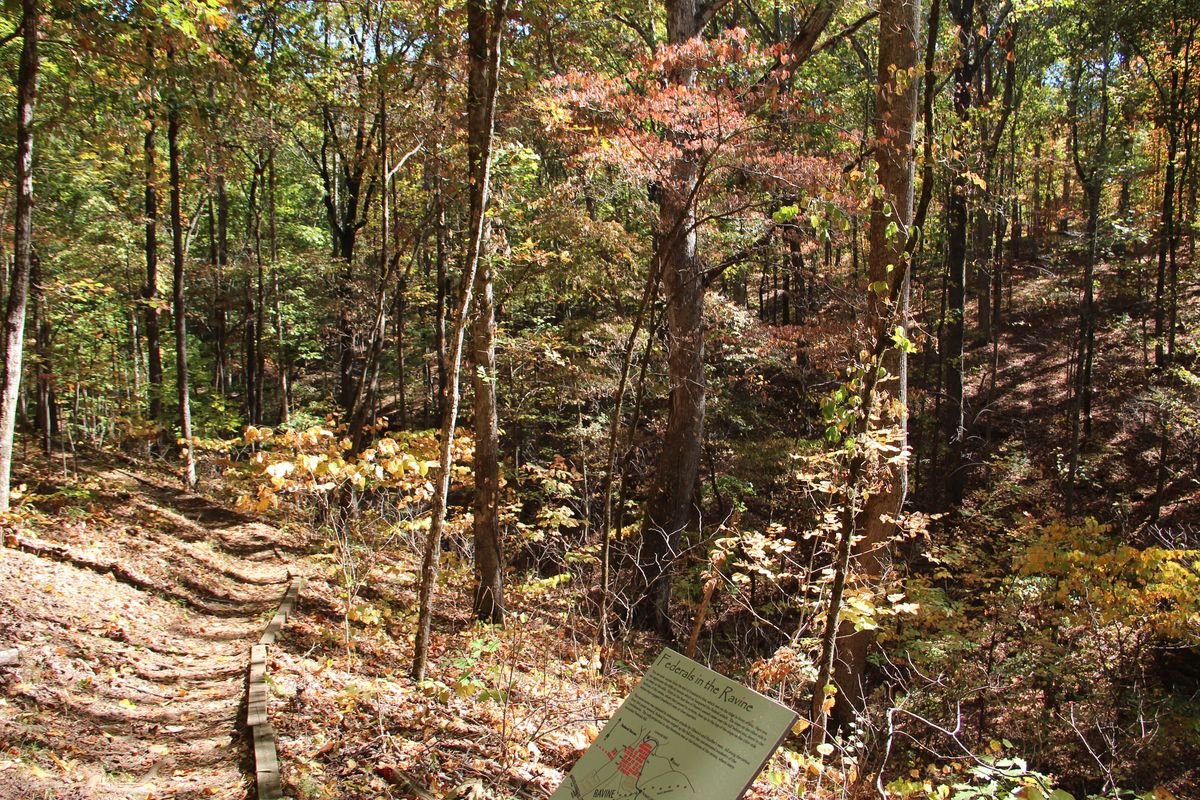
Pickett’s Mill is one of the best preserved Civil War battlefields in the nation. Visitors can travel roads used by Federal and Confederate troops, see earthworks constructed by these men, and walk through the same ravine where hundreds died. In Dallas, GA. More on Pickett’s Mill
Dug Gap Battle Park
Confederate breastworks from the February and May 1864 fighting at Dug Gap still line the ridge, with a scenic view from the top of Dug Gap Mountain. Open during daylight hours. From I-75 Exit 333 in Dalton, go west 1.6 miles on Walnut Ave. and Dug Gap Battle Rd.; the park is on the right. Phone: 706-278-0217 or 800-331-3258.
Gilgal Church Battle Site
During the Atlanta Campaign, holding this crossroads was Patrick Cleburne's division, Hardee's Corps, Army of Tennessee (CS). Attacked by Hooker’s XX Corps on the afternoon of June 15, 1864. At the close of the day, the Confederates still held the crossroads, however commanding general Joseph Johnston ordered a withdrawal to the Lost/Pine/Brushy Mountain line a mile or two to the east during the night. Georgia Historical Markers at this site describe the action. Note: Current Gilgal Church is a few hundred yards west down Due West Road. The wartime church was at this point. Phone: 770-428-4815 - Address: 667 Kennesaw Due West Road, Kennesaw, GA 30152
Cassville
An "almost" battle (town was burned; Confederate cemetery stands, plus marker for courthouse square). Cassville was created by the Georgia Legislature in 1832 to serve as county seat for simultaneously created Cass County (now Bartow), one of ten original counties carved from the former Cherokee territory. More on Cassville
Jefferson Davis Memorial Historic Site
This is where Jefferson Davis and his family were captured by Federal cavalry. When Confederate President Jefferson Davis and a few remaining staff members crossed the Savannah River into Georgia on May 3, 1865, they were headed for the Western theater of war where Davis planned to unite rebel forces and continue fighting for the 'lost cause.' On May 9, 1865, they camped in this pine forest, not knowing that pursuit was so close behind. At dawn, they were surrounded by two Union cavalry groups who were unaware of each other's presence. Gunfire ensued until the federal forces realized they had been shooting at one another. Two Union cavalrymen died during the skirmish. Davis was taken prisoner and held in Virginia for two years until released. Today, a monument marks the spot where he was arrested. Visitors can tour the 13-acre historic site that includes a museum and more. Phone: 229-831-2335 - Address: 338 Jeff Davis Park Rd, Fitzgerald, Georgia 31750 - Directions: I-75 south to Irwinville Exit; 1.5 miles north of Irwinville, off GA 32.
Forts
Fort Pulaski National Monument
The Battle for Fort Pulaski in April 1862 was a turning point in military history featuring the first significant use of rifled cannons in combat. These accurate, long-range weapons shattered Fort Pulaski's walls from over 1 mile away. After 30 hours of bombardment, the fort surrendered. The battle surprised military strategists worldwide, signaling the end of masonry fortifications. Located in Tybee Island. More on Fort Pulaski
Fort McAllister State Park
Located on the bank of the Great Ogeechee River south of Savannah, this park is the home of the best preserved earthwork fortification of the Confederacy. The sand and mud earthworks were attacked seven times by Union ironclads, but did not fall until captured in 1864 by Gen. William T. Sherman during his "March to the Sea." Nestled among giant live oaks and beautiful salt marsh, this park is a quiet location for camping, hiking, fishing and picnicking. In Richmond Hill, Georgia. More on Fort McAllister.
Old Fort Jackson
Built in 1808 and garrisoned in the War of 1812, Old Fort Jackson guarded the Savannah River approach to the city. It was enlarged and strengthened in 1845 and 1860 and held by Confederate troops during the Civil War. Today it has costumed interpreters and cannon firings. In Savannah, GA. More on Old Fort Jackson
Fort Tyler, West Point
On April 16, 1865, Union troops attacked the earthen fort in West Point, GA. Many soldiers lost their lives that day, unaware that Lee had surrendered to Grant 7 days prior. Fort Tyler boasted an impressive list of heavy artillery. The three cannon positioned there were strategically placed to protect against attack from two corners, while the heaviest piece was placed at another corner to protect the rail system and bridges below the hill. Phone: 706-645-1440. More on Fort Tyler
Museums
Atlanta History Center
Home of the DuBose Civil War collection. 'Turning Point: The American Civil War', located in the 9,200-square-foot Dubose Gallery, is one of the nation’s largest and most complete Civil War exhibitions. The museum has over 1,500 Union and Confederate artifacts, including cannons, uniforms, and flags, so visitors experience the Civil War through the eyes of soldiers and civilians. In Atlanta, Georgia. More on the Atlanta History Center
Battle of Atlanta Cyclorama
The restored Battle of Atlanta cyclorama painting moved from Grant Park to the Atlanta History Center in Buckhead, where it reopened in 2019. Stand at the center of the panorama of the July 22, 1864, battle. The steam locomotive Texas, a veteran of the 1862 Great Locomotive Chase, is displayed there too. At the Atlanta History Center, 130 W. Paces Ferry Rd., Atlanta. More on the Atlanta Cyclorama
Southern Museum of Civil War and Locomotive History
Home of the General, the locomotive stolen by Union spy James J. Andrews and his raiders in the 1862 Great Locomotive Chase. The museum also holds a large archive of Southern railroad company records, engineering drawings, photographs and correspondence. In Kennesaw, GA. More on the Southern Museum
National Civil War Naval Museum at Port Columbus
Formerly the Confederate Naval Museum, it features remains of the ironclad Jackson and the gunboat Chattahoochee. Open Mon-Sat 10 am - 4:30 pm and Sun 12:30 - 4:30 pm; closed on major holidays. Phone: 706-327-9798 - Address: 1002 Victory Drive, Columbus, Georgia 31901 Directions: Off US 280 near bridge in Columbus.
Drummer Boy Civil War Museum
Behind a plain turn-of-the-century storefront on Andersonville’s main street, Gerald Lamby’s Drummer Boy Civil War Museum shows uniforms, guns, swords, documents and photographs. Hours vary by season; call ahead. Phone: 229-924-2558. Address: 109 Church St., Andersonville, GA 31711. More on the Drummer Boy Museum
Allatoona Lake Visitor Center (Army Corps of Engineers)
The Corps of Engineers visitor center at Allatoona Dam has exhibits on Cooper’s Iron Works, an Etowah River ironworks destroyed in the Civil War. Phone: 678-721-6700. Located at the end of Ga. Spur 20 at Allatoona Dam. Directions: I-75 to exit 290, then east on Highway 20 to Spur 20 (designated GA 294 on some maps). Travel south on Spur 20 four miles to the center.
Georgia State Capitol Flag Collection
The Capitol’s Civil War flag collection includes the Secession Flags, Confederate Battle Flag, First National Flag of the Confederacy, Second National Flag of the Confederacy, and Third National Flag of the Confederacy. In Atlanta, Georgia. More on the Civil War flags
Stone Mountain Park
See how the community was affected by the Civil War and how Stone Mountain granite helped build the local economy. The Confederate Memorial on Stone Mountain is the largest relief carving in the world. The park museum at Memorial Hall has been closed for renovations; check the park’s website before you go. Phone: 770-498-5690 - Address: 1000 Robert E. Lee Blvd., Stone Mountain, Georgia 30083
Washington Historical Museum
As the oldest house museum in Washington, this museum contains an intimate collection of artifacts, memorabilia and antiques representing more than 200 years of history in Washington & Wilkes County, Georgia. This historic Ante-bellum home features a Confederate gun collection. Located in Washington, Georgia. More on the Washington Historical Museum
Prisons, Cemeteries and Memorials
Andersonville National Historic Site
Andersonville was the largest Confederate military prison and is now a national memorial to all American prisoners of war. The site preserves Camp Sumter, the prison itself, manages Andersonville National Cemetery and houses the National Prisoner of War Museum. In Andersonville, GA 31711. More on Andersonville National Historic Site
National Prisoner of War Museum
Dedicated to the men and women of this country who suffered captivity so that others may remain free. Their story is one of sacrifice and courage; their legacy, the gift of liberty. Phone: 229-924-0343. Address: 496 Cemetery Road, Andersonville, Georgia 31711 More on the National Prisoner of War Museum
Resaca Confederate Cemetery
Dedicated October 25, 1866, Resaca Confederate Cemetery is known as Georgia’s first Confederate cemetery. More than 450 soldiers who died at the Battle of Resaca, May 14 and 15, 1864, are buried here, 424 of them in graves marked unknown. From Dalton, take U.S. 41 south; the entrance is at the Whitfield-Gordon county line. More on the Battle of Resaca
Dalton Confederate Cemetery and Memorial Wall
The Confederate section of West Hill Cemetery holds 421 Confederate soldiers and four unknown Union soldiers, with the Confederates’ names engraved on a memorial wall. It is to the right of the rock chapel inside the cemetery, near downtown Dalton. From I-75 Exit 333, go east 1.6 miles on Walnut Ave., left on Thornton Ave. for 1 mile, then left on Cuyler St. to the cemetery entrance. Phone: 706-270-9960 or 800-331-3258. Address: Emory St., Dalton, GA 30720.
Railroads, Mills and Industry
Ringgold Depot
Ringgold’s stone depot stands on the Western & Atlantic Railroad, the state-owned line from Atlanta to Chattanooga that is still owned by Georgia and leased to CSX. The W&A was the route of the Andrews Raid, the Great Locomotive Chase of April 12, 1862, and the depot saw fighting at the Battle of Ringgold Gap in November 1863. From I-75 Exit 348, go east on Ga. 151 to U.S. 41, turn right, pass under the railroad bridge and take the first left. More on Ringgold Gap
Tunnel Hill and the Clisby Austin House
Built to connect the Port of Augusta to the Tennessee River Valley, the tunnel through the Chetoogeta Mountain was to be part of the first railroad across the Appalachian Mountains, and open trade between the eastern coast region and the upper Midwest. Construction began on the tunnel in 1848, during which the city of Tunnel Hill sprung up from people moving here to supply accommodations to the railway workers. The tunnel, which spans 1,477 feet, was dug through the base of the mountain. More on the Tunnel Hill Heritage Center
Confederate Powderworks and Sibley Mill, Augusta
About 2,750,000 pounds of gunpowder were made here. At the beginning of the Civil War gun powder supplies for the Confederate armies were insufficient. In 1861 Jefferson Davis, president of the Confederacy, charged Colonel George Washington Rains with solving this issue by creating a local supply of gun powder. Located in Augusta, Georgia. More on the Augusta Canal and Sibley Mill
Columbus Iron Works
For more than a century the Columbus Iron Works, south of the Dillingham Street Bridge, made goods for homes, farms, steamboats and mills. As the Confederate Naval Iron Works it built machinery for Confederate ships. The restored buildings are now a convention center. In Columbus, GA. More on Columbus Iron Works
New Manchester Mill Ruins, Sweetwater Creek State Park
See a peaceful tract of wilderness only minutes from bustling downtown Atlanta. The most popular trail (red) follows the free-flowing stream to the ruins of the New Manchester Manufacturing Company, a textile mill burned during the Civil War. In Lithia Springs, Georgia. More on the New Manchester Mill ruins
Prater’s Mill
Now listed on the National Register of Historic Places, Prater's Mill's heritage runs back to the days of the Cherokee Indians. During the Civil War, the mill was used as a campsite by soldiers from both sides. While occupied by the Union army, the mill was considered a valuable resource for food and was not destroyed. The Prater family operated the Mill until the 1950's. In Dalton, Georgia 30721. More on Prater’s Mill
The U.S. Arsenal, Augusta
Seized by state troops only days after Georgia seceded, the arsenal is now part of Augusta University’s Summerville campus. Phone: 706-737-1444 - Address: 2500 Walton Way, Augusta, Georgia
Historic Homes and Towns
Alexander H. Stephens State Historic Park
This site combines the recreational fun of a state park with the educational resources of a historic site. Named for the vice president of the Confederacy and later governor of Georgia, A.H. Stephens State Historic Park features a Confederate museum with one of the finest collections of Civil War artifacts in Georgia, including uniforms and documents. Stephens' home, Liberty Hall, is renovated to its 1875 style, fully furnished and open for tours. Beautiful outdoor facilities make this park a treat for both nature lovers and history buffs. Located in Crawfordville, GA. More on A.H. Stephens State Historic Park
Barnsley Gardens
The house was built on an acorn-shaped hill reputedly cursed, and Indian legend warned it should be avoided as an unlucky site. But, having enjoyed a Midas Touch, perhaps Barnsley was unconcerned with local legend. The later life of Godfrey Barnsley was in tragic contrast to the early years that had made him one of South's wealthiest men. Fortune changed for Barnsley shortly after moving his family to Woodlands. More on Barnsley Gardens
Bellevue, LaGrange
The Greek Revival home of Benjamin Harvey Hill, lawyer, Georgia legislator and U.S. congressman and senator, is regarded as one of the finest examples of the style in Georgia. Federal soldiers arrested Confederate Navy Secretary Stephen Mallory and Hill here in 1865. Phone: 706-884-1832. Address: 204 Ben Hill St., LaGrange, GA 30240.
Bulloch Hall
Completed in 1839 for Major James Stephens Bulloch, one of Roswell's founders, Bulloch Hall is a Greek Revival structure and one of the South's finest examples of true temple-form architecture. In 1853, Major Bulloch's daughter, Mittie Bulloch, married Theodore Roosevelt, Sr. (Thee) in the dining room of the house. Their son, Theodore Roosevelt became our 26th President. Located in Roswell, Georgia. More on Bulloch Hall
Green-Meldrim House
The house next to St. John’s Church was designed and built between 1853 and 1861 by architect John Norris at a cost of $93,000. It was also General Sherman's headquarters during Federal occupation of Savannah. In Savannah, Georgia - More on the Green-Meldrim House
Jarrell Plantation State Historic Site
Nestled in the red clay hills of Georgia, this cotton plantation was owned by a single family for more than 140 years. It survived Gen. Sherman's "March to the Sea," typhoid fever, Emancipation, Reconstruction, the cotton boll weevil, the advent of steam power and a transition from farming to forestry. In Juliette, Georgia. More on Jarrell Plantation
Kennesaw House
Built as a cotton warehouse by John Glover in 1845, the Kennesaw House is one of Marietta's oldest buildings. Dix Fletcher purchased the warehouse in 1855, and after remodeling it, opened the Fletcher House Hotel in its place. During the early years of the Civil War, the hotel was used as a Confederate hospital and a morgue. In Marietta, Georgia. More on the Kennesaw House
Cannonball House, Macon
This southern home, c. 1853, is named for damage sustained during the Civil War. Listed on the National Register of Historic Places, it is an example of authentic Greek Revival architecture containing fine period furnishings. At the rear of the Cannonball House stands a quaint two-story kitchen house built of hand-molded brick. The upper level of this house housed enslaved household workers. Few structures of this type remain in the South today. A Civil War military collection features officers' uniforms, company flags, swords, and guns used by Georgians during the War Between the States. Phone: 478-745-5982 - Address: 856 Mulberry St, Macon, Georgia 31201
Old Governor’s Mansion and Old Capitol, Milledgeville
Completed in 1839, the Old Governor's Mansion is one of the finest examples of High Greek Revival architecture in the nation. It was the seat of Georgia's government during the Civil War. Designed by noted architect Charles Cluskey, an Irish immigrant, and built by Timothy Porter of Farmington, Connecticut, the Mansion looms over Milledgeville with its stately columns. Located in Milledgeville, Georgia.. More on the Old Governor’s Mansion
Robert Toombs House State Historic Site
Toombs, an ardent secessionist, was the Confederacy's first Secretary of State. A legend in his own time, Robert Toombs was a successful planter and lawyer who led a turbulent career as state legislator, U.S. Congressman and Senator. "Defend yourselves; the enemy is at your door!" thundered Toombs from the Senate floor on January 24, 1860. Located in Washington, Georgia. More on the Robert Toombs House
Madison
Madison has the largest designated historic district in Georgia, which encompasses most of the town. During the Civil War, Sherman's Army spared Madison destruction because it was the home of pro-Union Senator Joshua Hill. Phone: 706-342-4454 or Toll Free 800-709-7406 - Directions: Take I-20 east to Madison exit; then US 129 north.
 Chickamauga Battlefield
 Battlefield Monuments
 Memorials
Common Questions
What is the most important Civil War site in Georgia?
Chickamauga, in northwest Georgia, was the largest battle fought in the state, in September 1863, and the battlefield is the heart of the first national military park. For the 1864 Atlanta Campaign, Kennesaw Mountain and Pickett’s Mill are the best-preserved battlefields.
Where can I see the Battle of Atlanta cyclorama?
At the Atlanta History Center in Buckhead, where the restored painting reopened in 2019 after moving from Grant Park. The Texas locomotive from the Great Locomotive Chase is displayed there too.
Where can I see the General locomotive?
At the Southern Museum of Civil War and Locomotive History in Kennesaw, the old Big Shanty, where Andrews’ raiders stole the General on April 12, 1862.
Are there Civil War sites on the Georgia coast?
Yes. Fort Pulaski National Monument near Tybee Island, Fort McAllister in Richmond Hill and Old Fort Jackson in Savannah are all open to visitors, and the Green-Meldrim House in Savannah was Sherman’s headquarters after the March to the Sea.
Sources we checked
Facts in this page were checked against the agencies and operators that run these places:
- National Park Service: Kennesaw Mountain National Battlefield Park
- National Park Service: Chickamauga and Chattanooga National Military Park
- National Park Service: Andersonville National Historic Site
- National Park Service: Fort Pulaski National Monument
- Georgia State Parks: historic sites
- Atlanta History Center
Spot something out of date? Email Contact@n-georgia.com and we’ll check it against the official source. Read how we research our guides.