Discover Historic Midway Georgia National Park
District - The colonial town of Midway, founded in 1752 by the New England Puritans, was once an influential center for political, economic and religious life.
Victorian District
These colonists were strongly in favor of independence from Great Britain, and during the Revolution the British burned the church and most of the buildings in the town.
Midway is located in Liberty County, Georgia on Highway 17 between Savannah and Darien and has a long and distinguished history.
English Puritans founded the Midway Society on August 28, 1754 in a log meeting house on Midway Neck. The Midway Society was a strongly religious Congregationalist group. These Puritans migrated to St. John's Parish, Georgia from Dorchster, South Carolina (near Charleston) in 1752 and established a new Dorchester and another nearby settlement what was later to become the Midway Community.
In 1752 the Council of Georgia granted the settlers 31,950 acres primarily because colonial officials wanted a large number of settlers there to protect them from the Creek Indians. The original settlers where primarily rice planters and developed a strong agricultural economy.
The settlers in this area were very political and took an an early stand for independence. In May of 1775, Lyman Hall (a Midway Church member) was sent to the Continental Congress in Philadelphia as a delegate from the parish of St. John.
A year later Hall and St. John's Parish resident Button Gwinnett (along with George Walton of Augusta) signed the Declaration of Independence. Another Midway resident, Nathan Brownson, served in the Continental Congress from 1776 to 1778, but was absent from the Signing.
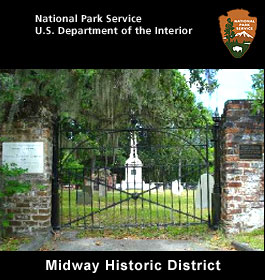
In 1777 St. John's Parish, St. Andrew's Parish, and St. James' Parish combined to become Liberty County. Because St. John's Parish was the first in Georgia to vote for liberty, the new county created was given the name Liberty. Historic landmarks include the Midway Church and Cemetary and Midway Museum (collectively known as the Midway Historic District).
Established in 1752, the the Midway Congregational Church building was destroyed during the Revolutionary War. The present building (which still stands) was completed in 1792. The religious welfare of the slaves was given high consideration. The "colored" members of the church worshiped with whites throughout the entire existence of the church. On Sundays, the two races worshiped together, with the blacks in the galleries and the whites in the pews below.
Every April, the Midway Society conducts an annual service commemorating the town's settlement. The Church and the adjacent cemetery were placed on the National Register of Historic Places in 1973. Among those buried here are Daniel Stewart and James Screven, two American Generals of the Revolutionary War. In the center of the cemetery there is a large monument dedicated to these men. The monument was dedicated in 1915.
The church was rebuilt in 1792. Also remaining to represent the colonial era of Midway are the historic 1756 cemetery and a segment of the historic "Old Sunbury Road" now a portion of Georgia highway 38. A museum modeled after the houses that once stood in Midway is also located in the district.


























 Coast and Islands National Parks
  These colonists were strongly in favor of independence from Great Britain, and during the Revolution the British burned the church and most of the buildings in the town.