Explore Blackbeard Island National Wildlife Refuge in Townsend Georgia
General Info
Refuge is a barrier island off the GA Coast. The island is part of the Savannah Coastal Refuges Complex headquartered in Savannah Georgia.
The full complex includes seven national wildlife refuges, totaling 56,949 acres, along a 100-mile stretch of coastline in Georgia and South Carolina.
The 5,618-acre island, northeast of Sapelo Island in McIntosh County, was named for Edward Teach, best known as "Blackbeard," a pirate who conducted raids on merchant shipping in the region in the early eighteenth century. Rumors of Blackbeard's buried treasure still flourish, but no evidence of his fortune has ever been discovered.
It was called Blackbeard Island as early as 1760, when the island was delineated as such on a survey map compiled by William DeBrahm and Henry Yonge.
Blackbeard Island was acquired by the Navy Department at public auction in 1800 as a source of live oak timber for ship building. In 1924 the island was placed under the jurisdiction of the Bureau of Biological Survey to be maintained as a preserve and breeding ground for native wildlife and migratory birds.
A presidential proclamation in 1940 changed its designation from Blackbeard Island Reservation to Blackbeard Island National Wildlife Refuge. In 1975, three thousand acres of the refuge were set aside as National Wilderness.
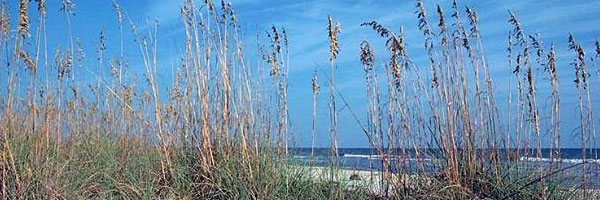
The island is comprised of interconnecting linear dunes thickly covered by oak/palmetto vegetation. There are approximately 1,163 acres of open freshwater or freshwater marsh, 2,000 acres of regularly flooded salt marsh, 2,115 acres of maritime forest, and 340 acres of sandy beach.
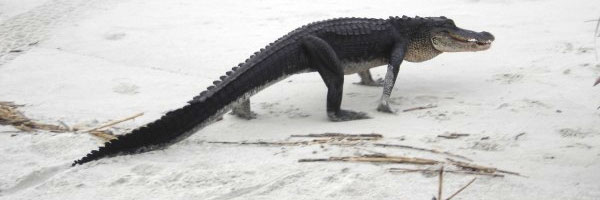
The primary objectives of the refuge are to provide wintering habitat and protection for migratory birds; provide protection and habitat to promote resident and migratory wildlife diversity; and to provide protection and management for endangered and threatened species (loggerhead sea turtle, wood stork, piping plover). Notable concentrations of waterfowl, wading birds, shorebirds, songbirds, raptors, deer, and alligators can be seen at various times of the year.
How to Get There
Blackbeard island is accessible only by boat, and transportation. Visitors are welcome to bring their own private watercraft, or arrangements for trips to the refuge can be made through local boat captains and marinas, as well as authorized tour guides. A public boat ramp on Harris Neck NWR (Barbour River Landing) may be used as a launching site for trips to the island. See charter boats that will take you there at the bottom of this page.
Amenities: Restrooms. Open: Daily Sunrise to Sunset. Free admission.
Blackbeard Island NWR Facts
Established: 1924 as a bird refuge and as an experiment station for the acclimatization of certainforeign game birds. Size: 5,618 Acres (1,163 freshwater impoundments/marsh; 2,000 saltwater marsh; 2,115 pine and oak forests; and 340 sand beach). Location: McIntosh County, Georgia, five miles north of Eulonia, GA, then six miles east on Harris Neck Road, then 18 miles southeast by boat. Federal ownership since 1800 Department of Navy and FWS. During 1880-1910, served as South Atlantic Quarantine Station. Established as a wildlife preserve in 1924 and formally a NWR in 1940. Wilderness area consisting of 3,000 acres designated in 1975. Notable concentrations of waterfowl, wading birds, shorebirds, songbirds, raptors, deer and alligators.
Provide wintering habitat and protection for migratory birds Provide protection and habitat to promote resident and migratory wildlife diversity Provide wildlife education, interpretation and recreational opportunities to the visiting public Provide protection and management for endangered and threatened plant and animal species (loggerhead sea turtle, American bald eagle, American alligator, wood stork and piping plover
Contact, Boat Charters & Website
Phone: 843-784-2468 - Location: Blackbeard island is accessible only by boat. The following offer charter boat access to island. Brethren of the Coast Coastal Fishing Charters - Captain Carl Pollock at 912-269-1718 Coastal GA Adventures - Captain Wild Bill at 912-884-4223 Captain Henderson Hope at 912-270-7965 Captain Howard Graham at 912-832-4024 Blackbeard Island National Wildlife Refuge (NWR) Website





























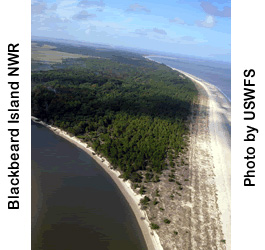 Refuge is a barrier island off the GA Coast. The island is part of the Savannah Coastal Refuges Complex headquartered in Savannah Georgia.
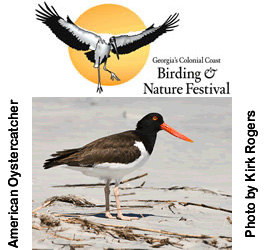 The primary objectives of the refuge are to provide wintering habitat and protection for migratory birds; provide protection and habitat to promote resident and migratory wildlife diversity; and to provide protection and management for endangered and threatened species (loggerhead sea turtle, wood stork, piping plover). Notable concentrations of waterfowl, wading birds, shorebirds, songbirds, raptors, deer, and alligators can be seen at various times of the year.