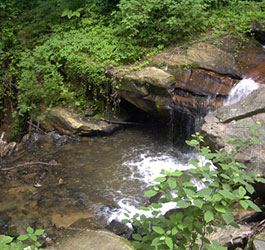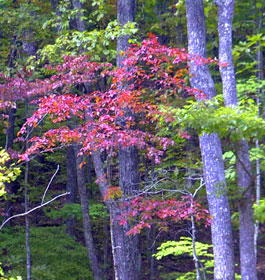
| Description After the Cherokee were removed from their "Great Blue Hills of God" (the Blue Ridge Mountains), loggers stripped the trees from the land and shipped them out via the railway. The main line of that railway ran along the Nantahala River, and evidence of it still exists in a Wilderness shared by Georgia and North Carolina (see North Carolina, Southern Nantahala Wilderness). Steep, rugged, reforested country cut by numerous streams and old drainages characterizes the southern end of the Blue Ridge Mountains. The streams feed the Nantahala, Hiwassee, and Tallulah Rivers, and the wide non-Wilderness right-of-way along the Tallulah neatly divides the Georgia share of the wildland. The eastern section is the northern portion of Georgia's Coleman River Wildlife Management Area. In both sections spruce and fir cover the ridges (opened by grass-heath "balds") and mixed hardwoods grow on the slopes. Elevations here are lower than in Tennessee. Several unique bogs support endangered species such as the bog turtle and rare combinations of other species found nowhere else in the world. Other than four miles of the Appalachian Trail, which runs north-south through the larger western section, you won't find developed pathways on the Georgia side. However, old roadbeds provide hiking access. Off these old roads and deep in the shade of the many trees, where the walking is difficult, you'll find Georgia at her most unspoiled. |
||
North Carolina Entry: |
||
|
||
| Area Management The Southern Nantahala Wilderness is part of the National Wilderness Preservation System, set up by the Wilderness Act of 1964 to keep these lands wild. Please use Leave No Trace practices when you visit. |
||
| General Wilderness Prohibitions As in all designated wilderness, motor vehicles, motorized equipment and mechanical transport (including bicycles, carts and wagons) are generally not allowed, and aircraft may not land. Contact the ranger district listed on this page about any exceptions. |
||
The following wilderness regulations are in effect for this area. Not all regulations are in effect for every wilderness. Contact the Forest Service office for more specific information about the regulations listed.
 Dogs Restricted - Leased-Under Control Pets must be on a leash at all times.
Outfitter guide or other special use permits granted by Chattahoochee-Oconee National Forest for use in wilderness areas.Campsite Restriction - In designated sites only
Maximum Group Size: 10 MembersMaximum Length of Stay: 14 DAYS Dogs Restricted - Leased-Under Control Pets must be on a leash at all times.
Outfitter guide or other special use permits granted by Chattahoochee-Oconee National Forest for use in wilderness areas.Campsite Restriction - In designated sites only
Maximum Group Size: 10 MembersMaximum Length of Stay: 14 DAYS |
||
| The priority for the Forest Service during the 1960's and 1970's was to restore badly eroded lands on the Oconee and restore forest health. During the 1960's construction efforts were undertaken to provide developed recreation areas within 50 miles of every major town. Brasstown Bald Visitor Information Center atop Georgia's highest mountain and Warwomen Dell are examples of areas built as a result of this effort. | ||
| The next four decades saw increased environmental legislation that governs management of the national forests to protect environmental quality and insure public involvement in the process. Wilderness areas were preserved, Wild and Scenic Rivers designated, and experts in natural resource management were employed to help meet the challenges. While the way we do things have changed many times over the years, our tradition of stewardship--caring for the land and serving people, is the same. | ||
|
||