
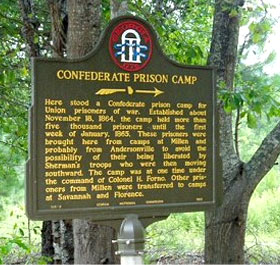
In the last weeks of 1864, the small railroad town of Blackshear in Pierce County became a hastily built prison camp for more than 5,000 Union soldiers, moved out of Sherman’s path during his March to the Sea. Today a Georgia historical marker on GA 203 marks the spot.
- WhenAbout Nov. 18, 1864, to early January 1865
- PrisonersMore than 5,000 Union soldiers
- CommandantCol. Henry Forno
- WhereMarker on GA 203, north of Cason Road, Blackshear
A Corral in the Pine Woods
As Maj. Gen. William T. Sherman’s army marched toward Savannah in November 1864, Confederate authorities emptied prison camps in its path. Prisoners from Camp Lawton at Millen, and probably some from Andersonville, were loaded onto the Atlantic & Gulf Railroad and sent deep into southeast Georgia. The first trainload of about 600 men arrived at Blackshear from Savannah on November 16, and within weeks the camp held more than 5,000.
There was no stockade. The camp was an open clearing in the pine woods beside a stream, ringed by a guard line with artillery trained on it, and the prisoners built their own shanties. The guards were few, and some men escaped at night. Local families, who had little themselves, shared what food they could.
In the Prisoners’ Own Words
John McElroy, 16th Illinois Cavalry
“After leaving the cars we were marched off into the pine woods, by the side of a considerable stream, and told that this was to be our camp. A heavy guard was placed around us, and a number of pieces of artillery mounted where they would command the camp.”
From Andersonville: A Story of Rebel Military Prisons (1879).
John L. Ransom, 9th Michigan Cavalry
“Fresh meat again to-day. Rebels go out to neighboring plantations and take cattle, drive them here, and butcher for us to eat. Rice is also given us to eat. Have plenty of wood to cook with.”
Diary entry, Dec. 4, 1864, from John Ransom’s Andersonville Diary.
What Happened Next
The camp lasted only a few weeks. As Sherman neared the coast, many prisoners were moved again, west to a temporary camp at Thomasville in mid-December, and others north toward South Carolina. According to the state historical marker, the Blackshear camp held prisoners until the first week of January 1865. Roughly two dozen Union soldiers are believed to have died here; their remains were later moved to Beaufort National Cemetery in South Carolina.
Visiting the Site
There is no visitor center or museum. The Georgia Historical Commission marker stands on GA 203 (Blackshear Highway), north of Cason Road in Blackshear, and is free to see anytime. For more on the area, see free outdoor things to do on the Georgia coast.
Sources we checked
Facts in this guide were checked in September 2026 against the agencies and operators that run these places:
- Georgia Historical Society, Confederate Prison Camp marker – marker text and location
- Georgia Historical Society, Civil War Prison Camp marker (Thomasville)
- John McElroy, Andersonville: A Story of Rebel Military Prisons (1879) – Yale Avalon Project
- John L. Ransom, Andersonville Diary – Project Gutenberg
- New Georgia Encyclopedia, Pierce County
Quotes are copied from the public-domain texts linked above.
Spot something out of date? Email Contact@n-georgia.com and we’ll check it against the official source. Read how we research our guides.