|
||
| Calhoun Square | ||
| Calhoun Square was laid out in 1851 and is one of the last squares. It is located on Abercorn Street with the cross streets being Taylor and Gordon. It was named for John C. Calhoun a well known South Carolina politician. Massie School and Wesley Monumental Methodist Church are on this square. | ||
| Chatham Square | ||
|
||
| Chippewa Square | ||
|
||
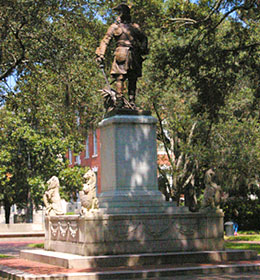
| Chippewa Square was laid out in 1815 and named for a battle in the War of 1812. In 1820, this square was a center of nighlife as the William Jay designed theater (still there although greatly altered) was on this square. The classical First Baptist Church and the Charles Cluskey designed Moses Eastman House at 17 W. McDonough are also on Chippewa. North of the square is Independent Presbyterian Church on Bull St. at Oglethorpe. The center of this square is James Edward Oglethorpe's monument. Oglethorpe Monument In 1901, the Colonial Dames, the Daughters of the American Revolution and other patriotic associations began to plan for a monument to the colony's founder. The Georgia Legislature allocated $15,000 for the project. The very prominent and well regarded Daniel Chester French and his associate Henry Bacon, were given the commission. French is famous for having also done the seated Lincoln in Washington, D.C. The statue depicts General Oglethorpe in a heroic pose, attired in the uniform of a British General of his period, with sword unsheathed, point held down. As was custom, it is facing his enemy which, in this instance, is South to Florida where the Spanish were. The figure of Oglethorpe is bronze and rests on a stepped, inscribed, pink-gray marble pedestal with garlands and pine cones on it. On the corners are rampant lions presenting shields at each corner. The shields show the following: 1. Coat of arms of Oglethorpe 2. Seal of the Colony of Georgia 3. Seal of the State of Georgia 4. Seal of the City of Savannah Two Italian Renaissance stone benches are on either side of the site. The statue itself is ten feet high. It was unveiled at a ceremony on November 23, 1910. |
||

Custom Search
|