|
|
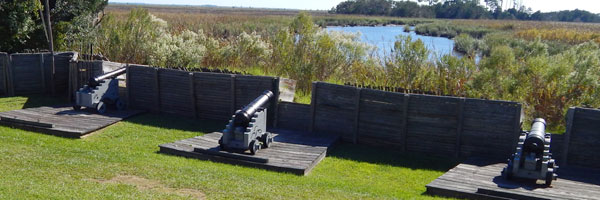
Fort King George Structure Established in 1721 to stop French and Spanish expansion, the fort was the southernmost outpost of the British Empire in North America.
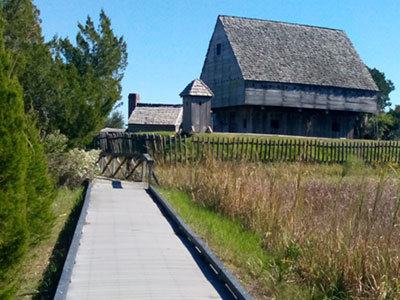
 The fort was destroyed by fire in 1726 and rebuilt the following year. The surviving portions of the first sawmill are significant and rare examples of early colonial industry in Georgia. A museum interprets the history of the area, including the early occupation of the site by the Guale Indians. The site also includes a reconstructed blockhouse. 1736, Fort King George was the southern outpost of the British Empire in North America. The fort was destroyed by fire in 1726 and rebuilt the following year. The surviving portions of the first sawmill are significant and rare examples of early colonial industry in Georgia. A museum interprets the history of the area, including the early occupation of the site by the Guale Indians. The site also includes a reconstructed blockhouse. 1736, Fort King George was the southern outpost of the British Empire in North America.
In cypress blockhouse, barracks and palisaded earthern fort were constructed in 1721 by scoutmen led by Colonel John "Tuscarora Jack" Barnwell. Using old records and drawings, this 18th century frontier fortification on the Altamaha River has been reconstructed for public tours. A museum and film cover the Guale Indians, the Santo Domingo de Talaje mission, Fort King George, the Scots of Darien and 19th century sawmilling when Darien became a major seaport. In addition to the fort replica, remains of three sawmills and tabby ruins are still visible. |
|
|
History - From 1721-1736, Fort King George was the southern outpost of the British Empire in N America. A cypress blockhouse, barracks and palisaded earthen fort were constructed in 1721 by scoutmen led by Colonel John "Tuscarora Jack" Barnwell.
 For the next seven years, His Majesty's Independent Company garrisoned the fort. They endured incredible hardships from disease, threats of Spanish and Indian attacks, and the harsh, unfamiliar coastal environment. After the fort was abandoned, General James Oglethorpe brought Scottish Highlanders to the site in 1736. The settlement, called Darien, eventually became a foremost export center of lumber until 1925. For the next seven years, His Majesty's Independent Company garrisoned the fort. They endured incredible hardships from disease, threats of Spanish and Indian attacks, and the harsh, unfamiliar coastal environment. After the fort was abandoned, General James Oglethorpe brought Scottish Highlanders to the site in 1736. The settlement, called Darien, eventually became a foremost export center of lumber until 1925.
Using old records and drawings, this 18th century frontier fortification on the Altamaha River has been reconstructed for public tours. Structures include a blockhouse, officers' quarters, barracks, a guardhouse, moat and palisades.
A museum and film cover the Guale Indians, the Santo Domingo de Talaje mission, Fort King George, the Scots of Darien and 19th century sawmilling when Darien became a major seaport. In addition to the many fort buildings, remains of three sawmills and tabby ruins are still visible. This site is on the Colonial Coast Birding Trail.
Amenities: Parking, Restrooms and Accessibility for mobility-impaired.
Call for hours and admission cost.
Phone: 912-437-4770 - Address: 1600 Wayne St., Darien Georgia 31305 |
|
|
|
|


Colonial Coast GA Travel Region Printable Map

GA Coast & Islands Fun:
Festivals & Events
Free Outdoor Activities
Tourist Centers
Travel Region Info
|