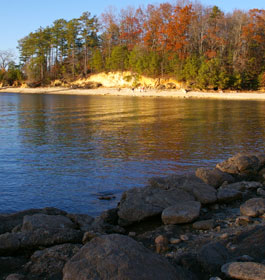
|
| General Lake Info |
Angling prospects are compiled by fisheries biologists and are based on sampling efforts of the Georgia Department of Natural Resources (DNR), knowledge of past fishing trends, angling experience and information provided by anglers and marina owners. For more information, contact the Wildlife Resources Division, Calhoun Fisheries office at 706-629-1259.
Fees - Many corps facilities have boat launch fees, user fees or both. Refer to contact information for pricing |
| Fish Attractors |
| The Carters Lake Fish Attractor Program was initiated in 1999 as a joint project between the Georgia Department of Natural Resources (GADNR), the United States Army Corps of Engineers (USACE) Carters Lake Project, local businesses and anglers. |
| Boat Ramps |
| There are 7 boat ramps. More info on boat ramps. |
| Best Fishing Bets |
|
| Largemouth Bass, Spotted Bass, Striped Bass and Hybrid Bass |
Largemouth Bass - About 10 percent of all black bass in the lake are largemouth. Despite the low percentage, those caught tend to be very healthy. Most will be just over a pound, but 7-8 pound fish are certainly not out of the question.
Technique - Fish larger u-tail or ribbon tail plastic worms. The classic pig-n-jig is also a successful largemouth technique in this impoundment.
Target - The lake's steep banks provide limited habitat for largemouth. Focus on coves, which typically provide the only shallow largemouth habitat in the lake. Fish toward the back of these coves in areas with submerged timber or fallen trees. |
Spotted Bass - Spotted bass are dominant. Their abundance will remain high in 2009, and growth is good. Thick-sided spots around 1 pound can be expected, but don’t let that fool you, there are plenty of 3-4 pound (or better!) magnum spots in these waters.
Technique - In spring, spots move shallow and can be caught using shad patterned, medium diving crankbaits or top water baits fished in the early and latter parts of the day. As the heat of summer sets in, slower presentations near deep (20-30 feet) structure are preferred. Try Texas rigged plastic worms, drop-shot rigs tipped with 3-4 inch plastic flukes or crawdad jig imitations. In fall crankbaits will again produce spots. Switch to ½ - ¾ ounce jigging spoons or live bait in winter.
Target - In early spring fish rocky main lake points. As spring progresses, spots move off the main lake points into cove areas to spawn. In summer, look for spots on deeper (20-30 feet) structure like brush piles or the 45 plus fish attractors created by the COE and DNR (see map link under 'Additional Information' below). Spots will feed aggressively on main lake points with the cooling of fall. Winter-time anglers should again fish deeper (50-60 ft.) structure in the lake. |
Striped Bass - Stripers range in size from 1 to 30 pounds in this impoundment. Most are 5 to 10 pounds, with the typical heavy weight in the 20-pound size class. An abundance of shad may afford anglers the opportunity to catch a lineside, rivaling the current lake record of 33 lbs., 5 oz.
Technique - Good numbers of stripers are caught each year on live bait presentations. Live trout or gizzard shad free-lined or fished 3-4 feet below balloon rigs when water temperatures are below 65 degrees (F) are hard to beat. When water temps are above 65 degrees (F), live offerings fished on downlines in 20-25 feet of water are recommended.
Target - During the cooler months from October through June, lineside fishing is best at Carters. Stripers can be found just about anywhere in the lake but the waters immediately adjacent to the Doll Mountain boat ramp and near the largest island in the Coosawatte River arm of the lake are both perennial hot spots. |
|
Walleye - Some limited natural reproduction occurs, but annual stockings of fingerlings primarily sustain the population. Now, with several consecutive years of walleye stocking, a modest, but stable population has been established. Fast growth will put the bulk of the fish stocked in the last two years in the 1-2 pound range. Fish stocked several years ago will be 5-plus pounds in size.
Technique - Jigging spoons, deep diving crankbaits and live bait such as minnows or night crawlers, fished on 3/8 ounce lead jigs are popular walleye techniques year-round. During the spring spawning run, walleye move shallow and can be caught with shallow running shad or minnow-colored baits.
Target - During the walleye spawning run (Feb. - Mar.), target rocky shorelines and points in the upper Coosawattee River arm of the lake above Ridgeway boat ramp. After spawning, fish areas with standing main lake timber and long rocky main lake points. As temperatures warm, concentrate on deeper structure where baitfish congregate during summer and fall. In late fall through winter, focus efforts again on rocky points in the Coosawattee arm of the lake. Regardless of season, night fishing can be a productive approach for walleye. |
Hybrid Bass - Despite continuous stockings of hybrids over the last five years, the population size has not yet reached its full potential. Hybrid numbers remain modest, but fish larger than 10 pounds will stretch lines in 2009.
Technique - Trolling artificial baits like u-rigs or crankbaits can be effective, but like stripers, live trout or shad are typically more consistent techniques. Wintertime hybrids may also hit cut fish bait or chicken livers fished on the bottom at near-shore locations.
Target - Hybrids are most often found close to schools of shad, which travel throughout the lake. Use your boat’s electronics to locate concentrations of baitfish because hybrids will likely be nearby. In summer, slow trolling down-lines in 20-30 feet of water should produce hybrids. There are also several mid-lake humps located in the lake where hybrids are known to frequent. |
Crappie - Though never overly abundant, 1/2 to 3/4 pound crappie are typical. Larger individuals will top 1- 1 1/2 pounds in size.
Technique - Crappie size minnows (1-2 inches) fished several feet below a bobber or small plastic jigs are recommended for the spring angler. Live minnows or jigs are used to target crappie on deeper structure outside the spring spawning months.
Target - Focus spring fishing efforts around standing timber, visible in a number of areas throughout the lake, as well as the cover offered under the few boat docks found in the lake. Fish deeper brush piles or other deep lake structure throughout the remainder of the year. |
Catfish - Channel catfish far outnumber flathead catfish at Carters. Channels are typically around 1 1/2 pounds, and the average flathead is usually 5-8 pounds in size.
Technique - Live or cut shad fished on weighted bottom rigs will produce dinner size catfish. Chicken livers, earthworms or catalpa worms are other common options for Carters’ “whiskered” resources.
Target the cracks and pockets found in rocky banks and points throughout the lake. Tangles of fallen logs and trees in the backs of coves are also likely hideouts for catfish. |
Other Fish Species - Yellow bass are present in high numbers, but the species tends to be small in size. Anglers are encouraged to harvest yellow bass because this illegal introduction competes with larger, more desirable game fish. Bluegill are abundant, although most fish will be less than 6 inches in length.
Technique - Yellow bass can be caught with a host of small lures. However, jigging 1/4 to 1/2 ounce spoons in and around structure is an effective approach for them. For bluegill action, a bucket of worms or crickets is all one needs.
Target - Outside of spring, fish for yellow bass near deepwater structure anywhere in the lake. In April and May, spawn-run yellow bass will concentrate in the upper reaches of the Coosawattee River Arm of the lake. For bluegill, the shallows found in the backs of most coves are typical places to find this species. |
| Additional Info |
| The COE, DNR and local volunteers actively work to improve fish habitat in Carters Lake. Anglers can find information about the program, as well as current maps with coordinates for 45-plus fish attractor sites created in the lake at the DNR Web site. |
| Contact Info & Website Link |
| U. S. Army Corps of Engineers - Phone: 706-334-2248 - U. S. Corps of Engineers Carters Lake Website |
|
|
|
Check these out:
 Carters Lake Recreation Carters Lake Recreation
Carters Lake Map
Carters Lake Vicinity Map

Georgia Lakes
WMA Public Fishing Areas
GA Fishing Lakes
Georgia Rivers & Map
GA Lakes & Rivers Map
Water Safety
|